Skip to content

Diego Zapata

Rosa Mena
Sandy Lara
Diego Zapata
Rosa Mena
Sandy Lara
The endemic Galapagos fur seal is typically thought of as the less common version of the Galapagos sea lion- the less popular sea lion if you will. However, many are surprised to find that the numbers of the two populations are actually quite similar. The difference is that, while the sea lion will lounge on any sunny beach it can find, the fur seal is more particular, preferring shady and rugged coastlines where explorers may have a hard time spotting them. Coastal exploration and some very specific walks are the only ways of finding them. Most populations of Galapagos fur seals are found on Isabela and Fernandina islands. Furthermore, visitors often mistake the fur seal for the sea lion due to their similar morphological traits. However, the fur seal maintains a few traits that make it particularly unique, as Galapagos species tend to be.
Appearance – am I seeing a water bear?
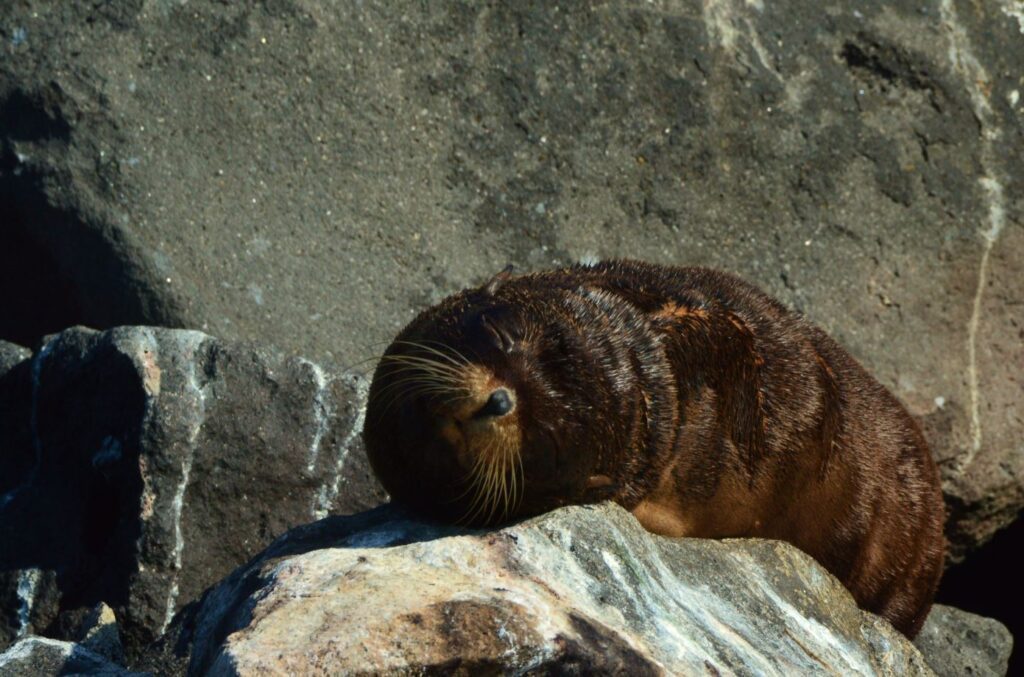
The fur seal’s scientific name is Arctocephalus galapagoensis, and it very simply means ‘bear headed’. This is, actually, quite an accurate description. The Galapagos fur seal has a short, pointed muzzle and a little button nose with large black eyes, giving it the face of a small bear. Indeed, its bear-like appearance is perhaps the best way to distinguish it from its close relative and neighbor, the Galapagos sea lion. Despite its ‘seal’ name, the Galapagos fur seal is a pinniped and is very closely related to the Galapagos sea lion, making it difficult to tell the two apart. The key difference is the coat. Fur seals have significantly thicker coats with longer guard hairs. On the other hand, the sea lion has a much pointier nose, while the Galapagos fur seal has a broader and shorter head. Fur seals also have more visible ears and are generally smaller than the sea lion. Overall size is different too; fur seals are smaller than Galapagos sea lions.
Adaptations of the Galapagos Fur Seal – show me some shade!
Because of their thick coats, fur seals have developed several behavioral and physical adaptions to survive in the Galapagos heat. Fur seals must keep their internal body temperature at approximately 37.7 °C and so have to thermoregulate their body temperature to avoid overheating. Mother fur seals teach their young to cool themselves in tidal pools, and in the shade of cliffs and rocks. Furthermore, their small size and ability to sweat allows them to release heat more efficiently than the sea lion. Their cardiovascular system also aids in cooling the animal by sending more blood to the flippers to dispense heat if it is warm and less if it is cold. Imagine yourself on a hot sunny day wearing a thick fur coat!
Behavior – look at me closely
Adult male fur seals are extraordinarily territorial, with approximately 30% of males dying in territorial fights every year. A male can mate with anywhere between six and sixteen females and lives with his females in an area of about 100 to 200 square meters. Males will frequently wander into another’s territory in search of a female, and defending such large territories can be difficult, thus the males do so aggressively. The Galapagos fur seal males storm their territory, threatening and fighting any males who get too close. In fact, they will only abandon their territory once they are completely depleted of all energy and must leave the land to eat.
Breeding – just one pup at a time
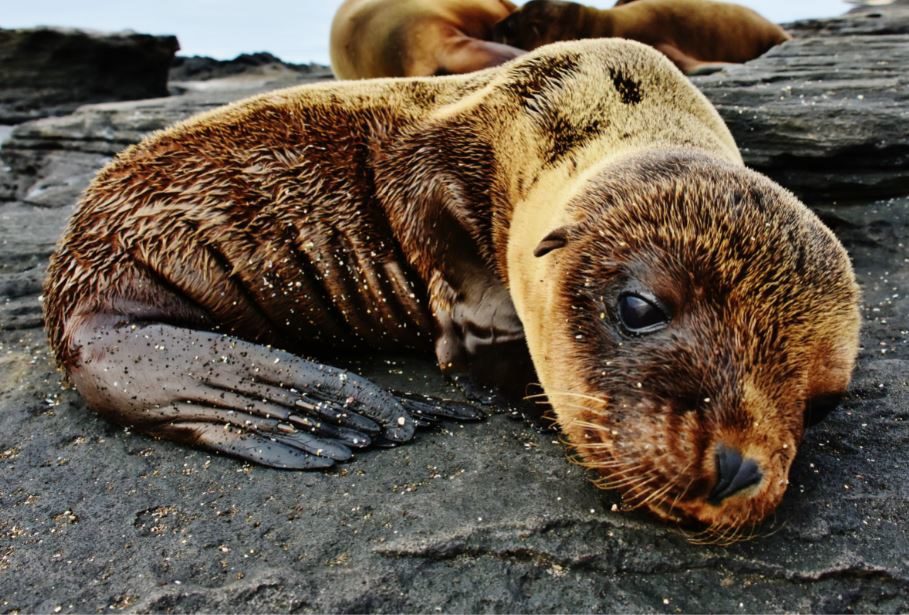
Females typically give birth to one pup between late September and early October, when the temperatures are cooler and there are higher levels of nutrients in the water. Galapagos fur seals have the longest nursing period of all fur seals, lasting for between one and two years, and sometimes extending even longer. The long nursing period could possibly be a mechanism to increase survival rates during periods of scarcity, for example during El Niño. However, as a result, females seldom give birth more than every two years and will rarely give birth if they are still nursing a pup. Unfortunately, the female is unable to care for two pups, so the second born has little chance of surviving, typically dying from starvation or siblicide.
Diving – we do it deeper!
The Galapagos fur seal is a nocturnal hunter and may dive to impressive depths to capture its prey- typically fish or small squid. Shorter dives range anywhere from 10 to 50 meters; however, longer dives can go beyond 100 meters. Females have been observed diving to a maximum depth of 169 meters.
Interestingly, the Galapagos fur seals seem to be very attuned to lunar cycles, and their feeding habits vary depending on the phase of the lunar month. All fur seals, including nursing females, feed significantly less during the full moon. One study found that foraging trips during the new moon lasted between 50-70 hours and only around 10-20 hours during the full moon. This could be due to the fact that they are more visible to predators during the full moon and that their prey moves deeper underwater to avoid the light.
Javier Garcia
Eduardo Silva

Carolina Escobar
Javier Garcia
Eduardo Silva
Carolina Escobar
Finding Galapagos Fur Seals – come and see me at the Equator
Best locations for finding fur seals during coastal exploration outings include Galapagos tours to islands like North Seymour, Floreana, Genovesa, Isabela, Fernandina, and Santiago. Perhaps the only location where you can actually walk through a visitor site along the coast and find fur seals is Puerto Egas, Santiago Island. One snorkeling location where fur seals are regularly seen is up north in Genovesa Island; the sheer cliffs near Prince Philip Steps provide easy access to the fur seals’ deep-water feeding habitat. Various exploration itineraries will bring visitors close to the unusual cool spots for finding fur seals.
Blog Reviewed by: Francisco Dousdebés
Image Credits: Francisco Dousdebés